
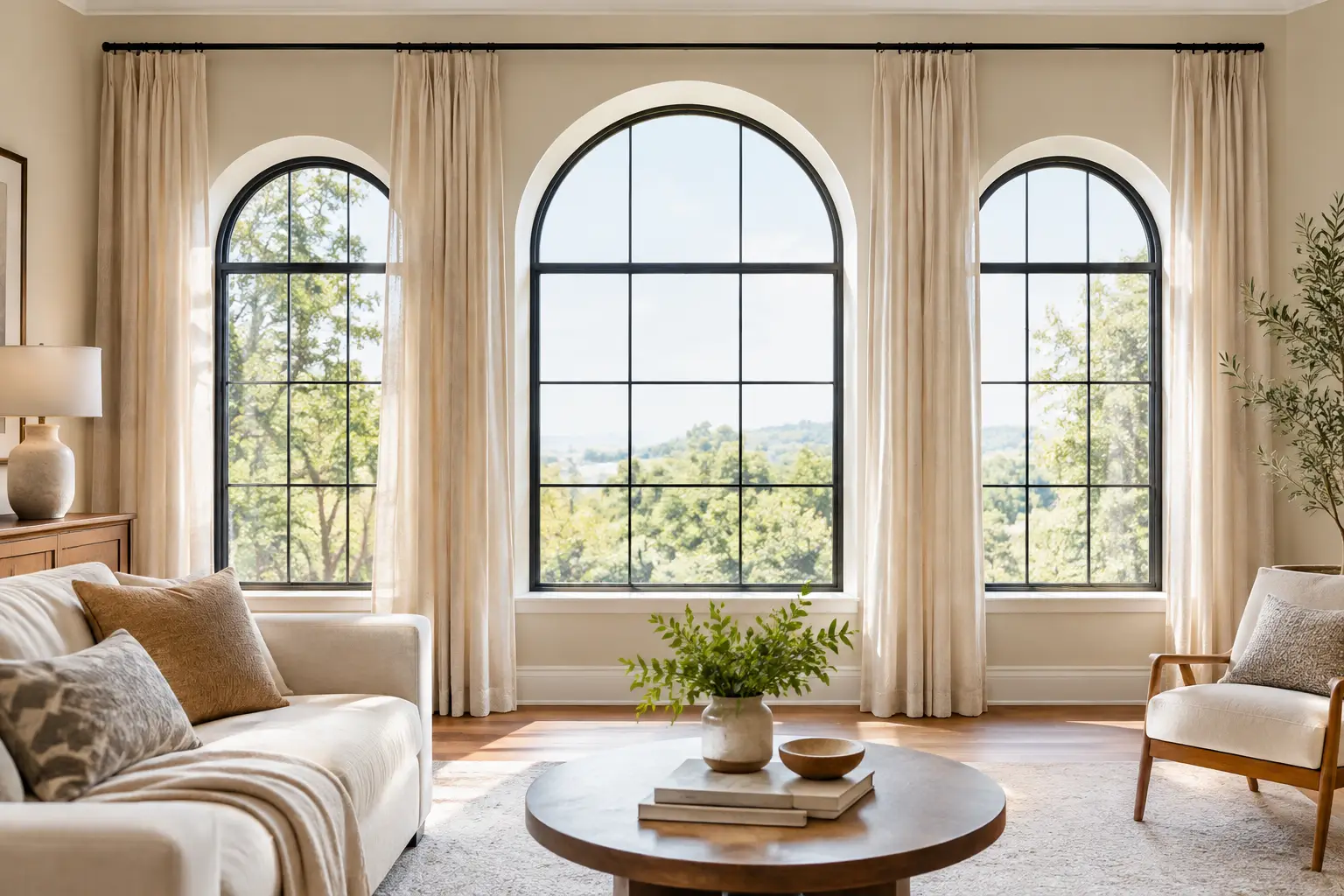
An arched window is often the feature that made you fall for a room. Its curve softens straight lines, draws the eye upwards and can bring wonderful light into a hallway, bedroom or sitting room. The question of how to dress arched windows is therefore not simply practical. The right treatment should provide privacy and comfort without hiding the character that makes the window special.
There is no single answer for every arch. The best choice depends on the window’s shape, where it sits in the room, how much light you want to retain and whether the treatment needs to open every day. With a careful measure and a considered design, even an unusually shaped window can feel beautifully resolved rather than difficult to furnish.
Start with the window, not the treatment
Before choosing fabric or a style, look closely at the architecture. Is the arch a gentle curve above a rectangular window, a full half-circle, a narrow Gothic point or part of a large glazed doorway? Does the window open, and is it overlooked? These details influence what will work well and where it can be fitted.
It is also worth deciding whether you want to celebrate the arch or soften it into the room. Leaving the curve visible makes a strong architectural statement, particularly in a period property or a room with high ceilings. Covering the full window with curtains can create a warmer, more traditional feel and may make sense where insulation, darkness or privacy matters more than displaying every line of the glazing.
A professional survey is especially valuable here. Arches are rarely as symmetrical as they appear from across a room, and even small differences in the brickwork, recess or plaster can affect the finished fit. Measuring the widest point, spring line and rise of the curve accurately is essential when ordering a shaped blind, shutter or track.
Curtains for arched windows: soft, flexible and timeless
Curtains are often the most forgiving way to dress an arched window, because they can be fitted above and beyond the opening. When open, they frame the arch rather than compete with it; when closed, they give the room softness, warmth and complete coverage.
For many homes, a straight pole or discreet track mounted above the highest point of the arch is the simplest and most elegant solution. Full-length curtains create a sense of height and work particularly well on tall windows in lounges, bedrooms and dining rooms. They can also make a modest window appear more generous, provided there is enough wall space at either side for the curtains to stack back.
The trade-off is that the arch will be hidden whenever the curtains are drawn. If preserving daylight is a priority, choose generous stack-back space, a well-positioned pole and a lighter heading such as wave or pencil pleat. A sheer or voile beneath the main curtains can provide daytime privacy while allowing the shape of the window to remain visible.
A shaped curtain track is another possibility for certain windows, particularly bay-style arches or wide curved glazing. This is a more specialist option and needs precise planning, as the curve, bracket positions and fabric weight must all work together. The result can be striking, but it is not always necessary for a simple arched opening.
Fabric choice matters as much as fitting. Linen-look weaves and soft cotton blends bring relaxed texture to a country-inspired room, while velvet or a heavier lined fabric gives a more formal finish and helps reduce draughts. In bedrooms, blackout lining can be added without compromising the look of the main fabric.
How to dress arched windows with blinds
Blinds can be a superb choice where space is limited or where you would like the window’s curve to stay on show. The key is choosing a style that suits the way the window is used.
Roman blinds below the arch
A Roman blind fitted within the rectangular part of the window is a popular and practical approach. It leaves the arched section uncovered, allowing natural light to enter through the top while giving privacy across the lower glazing. This arrangement works well in kitchens, bathrooms, landings and sitting rooms where you do not need complete blackout.
Roman blinds also bring the warmth of fabric without the fullness of curtains. With thousands of fabrics available, they can be coordinated with cushions, lampshades or curtains elsewhere in the room for a considered finish. Do remember that a blind fitted below the curve will not cover the whole window at night, so it may not be suitable for a street-facing bedroom.
Shaped pleated or cellular blinds
For a blind that follows the arch itself, shaped pleated and cellular designs can be made to fit the curve. These are usually fixed in place across the arched section, while a separate blind may operate below. They are ideal where privacy is needed throughout the window but you still want to retain its distinctive outline.
Cellular fabrics have the added benefit of helping to reduce heat loss and soften glare. However, a fixed shaped section cannot be raised out of the way, so the choice of fabric is important. A light-filtering fabric keeps the window bright, whereas a more opaque option offers greater privacy but will permanently reduce the light coming through the arch.
Roller blinds and practical lower sections
A roller blind can be fitted below the spring line of an arch, much like a Roman blind. It is neat, uncomplicated and particularly useful in kitchens or utility areas. Pairing it with a fixed sheer, shaped upper treatment can be an effective way to manage light while keeping the overall look clean.
Shutters: made for architectural detail
Plantation shutters are one of the most tailored ways to dress an arched window. Bespoke shaped shutter panels can be manufactured to follow a curve, creating a crisp, permanent-looking finish that enhances the window rather than concealing it.
For an arched window, the upper section is often designed as a fixed fan-shaped panel, with adjustable louvres below. This gives you control over privacy and daylight in the main part of the window while respecting the shape at the top. Shutters are particularly well suited to bathrooms, bedrooms, road-facing rooms and homes where a neat, low-maintenance treatment is preferred.
They are not the softest option visually, nor do they offer the same blackout effect as lined curtains. Yet their clean lines, durability and ability to sit close to the window make them an excellent choice where curtains would feel too bulky. In older properties, the right shutter colour can also complement original woodwork and architectural features beautifully.
Consider proportion, privacy and daily use
The most attractive solution is not always the most practical one. A full curtain treatment may look luxurious, but it needs room to draw back and may not suit a narrow landing. A fixed shaped blind may fit perfectly, but it will change the amount of light in the room all year round. This is where a little honest consideration before ordering pays off.
Think about how the room is lived in. In a bedroom, you may need darkness, warmth and privacy, making lined curtains over a blind a sensible combination. In a hallway, a shaped shutter or blind can preserve light while preventing people outside from looking in. In a sitting room, sheers and curtains may offer the greatest flexibility, providing privacy by day and a cosy finish in the evening.
Scale deserves attention too. Large arches can carry fuller curtains and bolder fabric patterns, while a small arched window usually benefits from a simpler treatment. If the room already has patterned wallpaper, strong furniture or decorative glazing, a plain textured fabric or a clean shutter design may allow the window to feel elegant without becoming overly busy.
Why bespoke fitting makes the difference
Ready-made treatments are designed for standard rectangles. They can be useful in some situations, but an arched window is rarely where compromises look convincing. A treatment that sits just below the curve, leaves uneven gaps or interrupts the opening mechanism can make a beautiful feature feel awkward.
Bespoke window dressings are planned around the exact dimensions of the window and the character of the room. From selecting a fabric that complements your furnishings to deciding whether a blind should sit inside or outside the recess, each detail affects the result. Professional fitting also ensures poles, tracks and shutters are safely fixed, evenly positioned and work as they should.
At Country Interiors, this considered approach is central to creating homes that feel complete. Advice, measuring, hand-finished making and fitting all work together, so you can choose with confidence rather than trying to solve a complex shape alone.
An arched window does not need to be treated as a problem to hide. Give it the right balance of function and attention, and it can become the detail that makes the whole room feel more personal, welcoming and beautifully finished.