
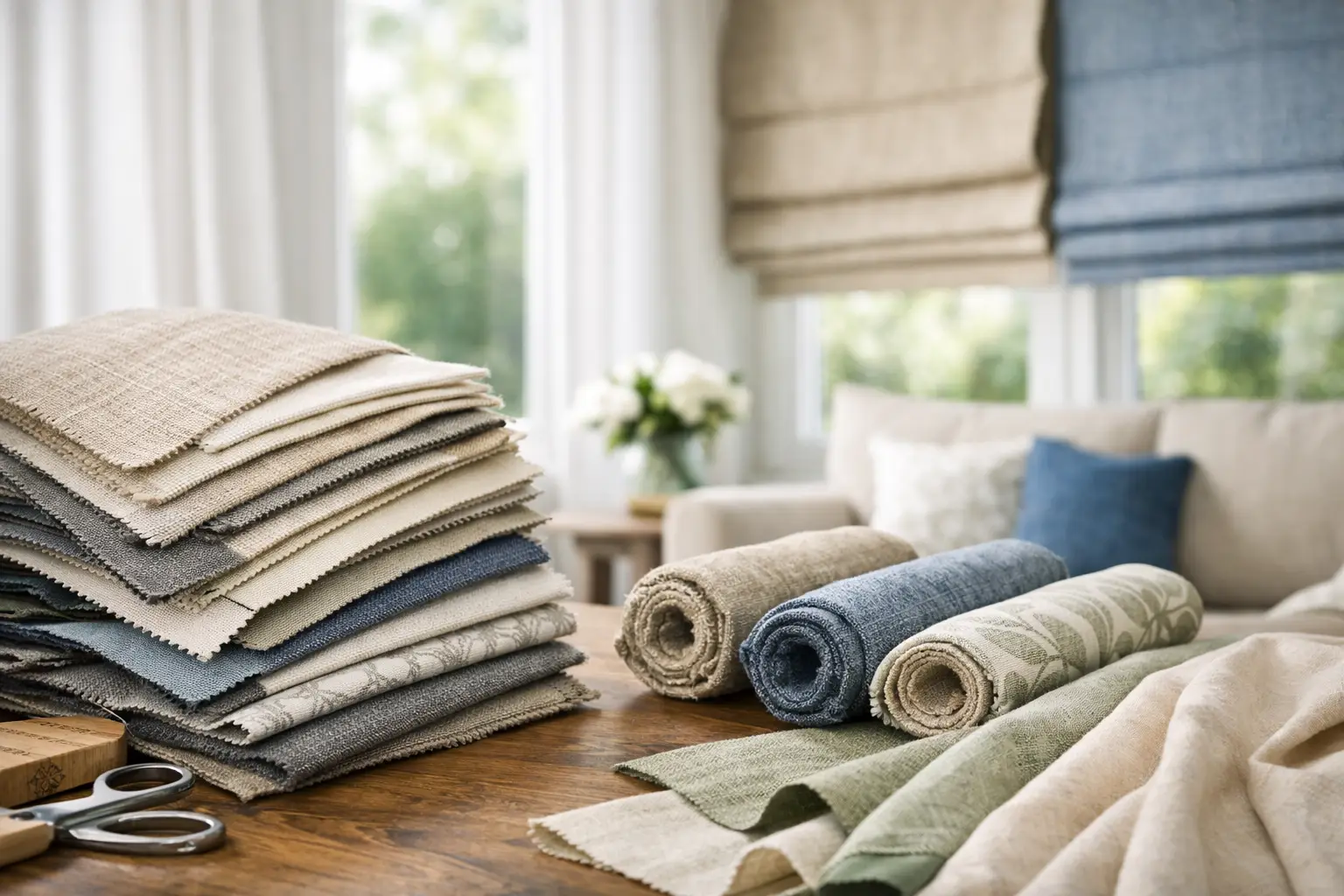
A Roman blind can make a window feel finished in a way few other treatments can. When raised, its fabric forms neat, soft folds; when lowered, it becomes a strong part of the room’s scheme. Choosing the right Roman blind fabrics is therefore about more than selecting a colour you like. The material affects how the blind hangs, how much daylight enters the room, how private it feels and how well it stands up to everyday life.
For a made-to-measure result, the fabric should work with both the window and the way you use the room. A beautiful linen-look weave may be ideal for a relaxed sitting room, for example, while a washable, more durable fabric may be the wiser choice in a busy kitchen or a child’s bedroom. The best choice balances the look you want with the practical comfort your home needs.
Why Roman blind fabrics deserve careful thought
Unlike a simple roller blind, a Roman blind gives the fabric centre stage. Its tailored folds show off pattern, texture and colour, which is why it can be such an effective way to introduce character without overwhelming a room. A patterned blind can bring warmth to a plain bedroom, while a softly textured neutral can add depth to a room built around natural materials.
The same fabric will not behave identically in every setting. Window size, the direction the room faces, surrounding furnishings and the blind’s lining all play a part. A fabric that looks light and delicate on a sample may appear deeper in tone when gathered into folds or viewed against a bright window. Seeing fabrics alongside your wall colour, flooring and upholstery helps ensure the final choice feels considered rather than isolated.
Weight and weave shape the finished folds
Roman blinds need enough body to form attractive, even folds. Medium-weight cottons, linens, linen blends and many decorative woven fabrics are popular because they offer a pleasing balance of structure and softness. They tend to sit neatly when lowered and fold well when raised.
Very lightweight fabrics can create a beautifully airy effect, particularly in a gentle, informal scheme, but they usually require careful lining and making. Heavier materials can give a more substantial, luxurious appearance, although they may be less suitable for particularly wide or frequently operated blinds. The scale of the window matters here: a large bay window may suit a fabric with body, while a small bathroom window can often carry something lighter and simpler.
Texture also changes the mood. Smooth fabrics feel clean and tailored; slubby linens and woven plains bring a relaxed, country-inspired finish; velvet and chenille can add richness to a formal sitting room or bedroom. There is no single right answer – it depends on whether you want the blind to quietly support the room or become a focal point.
Light, privacy and lining work together
Fabric alone does not decide how much light a Roman blind will block. The lining behind it is equally important. Standard lining gives a blind more substance, protects the face fabric and gently filters daylight. It is often a good choice for living rooms, dining rooms and spaces where softness matters as much as function.
Blackout lining is particularly useful in bedrooms, nurseries and rooms affected by early morning sun or nearby street lighting. It can significantly reduce light, although small amounts may still show around the edges of the blind depending on the fitting. Thermal lining can help add a further layer of insulation at the window, which is welcome in older properties or rooms that feel cooler in winter.
A darker fabric is not automatically better for privacy. At night, when lights are on indoors, even dark materials may reveal shapes if they are unlined. A well-chosen lining provides greater reassurance while also helping the blind retain its shape and colour over time.
Choosing Roman blind fabrics room by room
In a sitting room, comfort and personality often lead the decision. A softly patterned fabric can echo the colours in cushions, rugs or artwork without needing to match them exactly. If your room has several plain upholstered pieces, a Roman blind is an opportunity to introduce botanical prints, checks, stripes or a considered geometric design. In a smaller space, a fabric with a quieter pattern and a lighter ground colour will usually feel less dominant.
Bedrooms benefit from fabrics that create a restful atmosphere. Calming neutrals, gentle florals and muted blues or greens are enduring choices, but the practical priority is often better light control. Pairing a fabric you love with blackout lining can give you the decorative finish of a tailored blind without compromising on sleep. Where the blind will be fitted inside a recess, professional measuring is especially valuable for achieving a tidy, balanced appearance.
Kitchens and dining spaces often need a little more practicality. Choose fabrics suited to a room where moisture, cooking odours and occasional splashes are part of daily life. A tighter weave, a more forgiving colour or a subtle all-over pattern can be easier to live with than a pale, delicate plain. It is also sensible to keep fabric blinds well clear of hobs and sinks, both for safety and to protect the material.
For bathrooms, ventilation should guide the choice. Fabric Roman blinds can work in a well-aired bathroom, especially at a window away from direct splashing, but they are not always the best solution in a persistently damp room. A specialist adviser can help assess whether the position and conditions are suitable, or whether another blind style would offer better long-term performance.
Children’s rooms call for a balance of fun, durability and sleep-friendly light control. A fabric that will not show every small mark, combined with blackout lining, often makes day-to-day sense. Any blind should also be specified and fitted with child safety in mind, including an appropriate safety device for the operating chain.
Pattern, colour and scale
The most successful Roman blind fabrics relate to the rest of the room without making every item identical. If you already have patterned curtains, wallpaper or cushions, a textured plain may provide welcome breathing space. If the room is largely neutral, the blind can carry a bolder print and give the scheme a clear point of interest.
Pattern scale deserves particular attention. Large motifs need enough visible fabric to make an impact, so they are often better on wider windows. On a narrow window, a large repeat can become lost in the folds or appear fragmented. Small-scale designs and stripes are often more forgiving in compact spaces, although a vertical stripe can visually emphasise height while a horizontal effect may make a window feel wider.
Do not select colour only under shop lighting. Take fabric samples home and look at them in morning, afternoon and evening light. North-facing rooms can make cool shades feel greyer, while sunny south-facing rooms can intensify warm colours. This small step prevents a costly disappointment once the blind is in place.
The details that make a bespoke blind feel complete
A Roman blind is a practical window covering, but the finishing details give it its tailored character. The position of seams, the size of the folds, the chosen lining and the way the blind sits within or outside a recess all influence the final effect. These are details that are difficult to judge from a photograph or fabric swatch alone.
For this reason, a home consultation can remove much of the uncertainty. At Country Interiors, fabric choice can be considered alongside professional measuring, hand-finished making and fitting, so the blind is designed for the window rather than adapted to it afterwards. This is particularly reassuring for bays, unusually shaped windows and rooms where curtains, cushions or other soft furnishings need to work together.
It is worth thinking ahead, too. A fabric that feels fashionable but does not suit your home’s overall character may date quickly, whereas a well-made neutral or a timeless print can remain a pleasure for years. That does not mean every choice must be safe. It simply means choosing a statement you will still enjoy when the room has evolved around it.
The right fabric should make the room feel more like yours: comfortable in the daylight, private when evening comes, and pleasing every time you draw the blind up or down. A few carefully considered samples, measured against the real conditions of your home, are often where that confidence begins.