
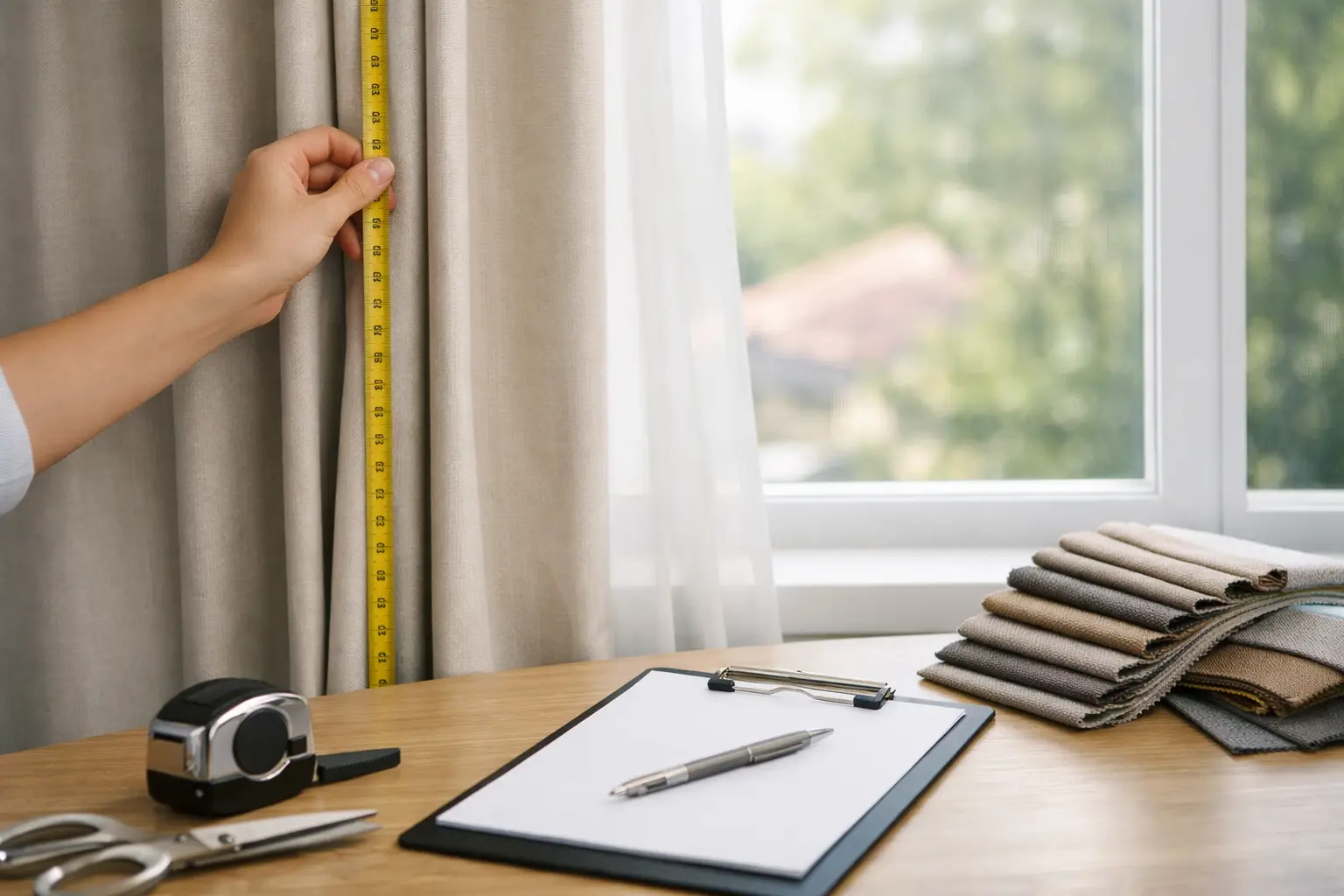
A beautiful pair of curtains can make a room feel finished, but the final look depends on the measurements being right. If you are wondering how to measure made to measure curtains, the good news is that the process is straightforward once you know what to look for. A few careful decisions at the start – especially around poles, tracks, headings and drops – make all the difference to how your curtains will hang.
For many homeowners, measuring is the part that feels most daunting. That is perfectly understandable. Windows are rarely as simple as they first appear, and details such as skirting boards, radiators, deep sills or bay shapes can affect the final result. The key is not to measure the glass itself, but the curtain track or pole and the finished drop you want the curtains to reach.
How to measure made to measure curtains properly
Before taking any measurements, decide whether your curtains will hang from a pole or a track. This matters because you do not measure the window width. You measure the actual width of the pole or track that the curtains will cover.
If you already have a pole or track fitted and you are happy with its position, use that as your starting point. Measure the full width of the pole between the finials, not including the finials themselves. If you are measuring a track, measure its total width from end to end. This gives the curtain maker the space the curtains need to cover when closed.
If the pole or track has not yet been installed, there is a little more judgement involved. In most rooms, a pole or track should extend beyond the window recess so the curtains can frame the window rather than block the light. As a general guide, allowing around 15 to 20cm each side often works well, but it depends on the proportions of the room and the style you want. Wider extensions can make a window feel grander, while a tighter fit may suit a smaller space.
Measuring the width
Width is usually the simpler of the two main measurements. Use a metal tape measure for accuracy and measure straight across the full width of the pole or track. Write down the measurement in centimetres.
Do not try to calculate fabric fullness yourself unless your curtain maker has specifically asked for this. Made to measure curtains are normally produced with the correct amount of fullness built in, depending on the heading style and fabric. Your job is to provide the finished track or pole width, not the total fabric width.
This is a point that often causes confusion. Ready-made curtains are sold by pair with a stated width, so people are used to thinking in terms of fabric size. Bespoke curtains work differently. The finished look is tailored around your exact window and your chosen heading.
Measuring the drop
The drop is the length of the curtain from the top fixing point to where you want it to finish. The right drop depends on both the type of fitting and the style of room.
If you are measuring for a pole with rings, measure from the underside of the ring to the chosen finishing point. If you are measuring for a track, measure from the top of the track to the finishing point. This distinction matters because curtains do not start at the top of the bracket or pole. They start where the fabric is actually suspended.
There are three common ways to finish the drop. Curtains can float just above the floor for a neat, practical look. They can lightly touch the floor for a softer, more classic finish. Or they can puddle slightly on the floor for a more decorative, luxurious appearance. In everyday family homes, just above or just touching the floor is often the most practical choice, especially in busier rooms.
If your curtains will finish at a sill or above a radiator, measure to the point where you want them to stop. A sill-length curtain usually finishes about 1 to 1.5cm above the sill. If there is a radiator below the window, you may prefer the curtains to finish 2 to 3cm above it so they sit neatly and move freely.
How to measure made to measure curtains for different window styles
Not every window can be treated in quite the same way. The basic principles stay the same, but awkward shapes and room features can call for a more considered approach.
Bay windows
Bay windows are one of the most common areas where measuring becomes tricky. The shape of the bay means the track or pole is often bent or made in sections. In this case, measure the full length of the fitted track or pole as it follows the bay, rather than trying to measure the window opening in a straight line.
For the drop, take measurements at several points across the bay because floors and window positions are not always perfectly level. Use the shortest drop if you want the curtains to hover above the floor. If you want them to touch the floor, a professional measuring service is often the safest option, as even small variations can show.
Recess windows
If your curtains are going outside the recess, which is the usual approach, measure the track or pole width and drop as normal. If you are fitting a track inside a deep recess, measure the exact recess width and check that there is enough room for the curtain stack when open. Heavy fabrics and fuller headings need more space than many people expect.
French doors and full-length windows
For doors and tall glazing, think carefully about access. Curtains that are slightly above the floor can be easier to open and less likely to catch. If the doors are used often, consider whether the curtains need to clear handles or nearby furniture. A lovely design still needs to work comfortably day to day.
Heading styles affect the measurement
One reason measuring can feel uncertain is that different curtain headings sit differently once made up. Pencil pleat, pinch pleat, wave and eyelet curtains all have their own proportions and hanging points.
Eyelet curtains hang directly from a pole and the fabric usually sits above the top of the pole, so the finished drop is measured differently from a curtain on rings. Wave curtains follow the shape of the track in a softer, more contemporary line, while pinch pleat curtains create a more tailored, classic appearance. The right choice is often about the room as much as the window.
This is where advice can be especially valuable. A heading that looks beautiful in a photograph may not be the best fit for your pole, your fabric or the way you use the room. Measuring is not only about numbers. It is about choosing proportions that suit the space.
Practical tips to avoid mistakes
Small measuring errors can have a noticeable effect, so it pays to slow down. Measure in centimetres, use a metal tape, and check each figure twice. It also helps to note whether each measurement relates to a track or a pole, and whether the drop is to the sill, radiator or floor.
Take account of anything that might interfere with the curtain line, such as skirting boards, window handles, deep sills or furniture placed close to the window. In older homes especially, walls and floors are not always perfectly straight. A curtain that looks right in one corner of the room may need a slight adjustment in another.
Photographs can help too. If you are discussing your curtains with a specialist, a clear picture of the window and surrounding area can highlight details that a written measurement alone might miss.
When professional measuring is worth it
There is nothing wrong with measuring curtains yourself, particularly for a straightforward window with an existing pole or track. But there are times when expert help brings real peace of mind. Bay windows, extra-wide openings, layered treatments, unusual wall conditions and full-room schemes all benefit from experienced eyes.
A professional measure does more than confirm width and drop. It considers bracket positions, stack-back space, fitting height, fabric weight and how the finished curtains will work with the room. That is often the difference between curtains that simply fit and curtains that look as though they truly belong.
At Country Interiors, this is part of the reassurance customers value most. When curtains are hand-finished and made specifically for your home, accurate measuring helps ensure the final result feels polished, balanced and beautifully considered.
Getting the measurements right is the first step towards curtains that do more than cover a window. They soften a room, frame the view and bring the whole interior together. If you are ever unsure, a little guidance at the measuring stage can save a great deal of guesswork later – and help your home feel every bit as finished as you imagined.