
A window can be perfectly placed, yet still leave a room feeling unfinished. The right blind brings softness, privacy and practical control over daylight, while tying the colours and textures of a scheme together. This made to measure blinds guide will help you understand the choices involved, from selecting a style to deciding when professional measuring and fitting are worth having.
Off-the-shelf blinds have their place, particularly for a temporary solution. But windows are rarely as standard as they first appear. Recesses may be uneven, frames may sit close to walls, and one or two millimetres can affect how a blind hangs and operates. A bespoke blind is designed around the individual window and the way you live in the room, giving the finished space the considered feel that turns a house into a home.
Why choose made to measure blinds?
The most immediate benefit is fit. A made-to-measure blind is produced to the measurements of your window, rather than asking you to adapt a ready-made size. This means cleaner lines, better coverage and fewer awkward gaps at the sides. It also gives you more freedom over where a blind sits, whether inside a recess, outside it or above a door.
The choice of materials matters just as much. Ready-made ranges can be limiting when you are trying to coordinate a blind with existing curtains, upholstery, paintwork or a favourite wallpaper. With bespoke options, you can select from a much broader palette of fabrics, textures and linings, then choose details that suit the character of the room.
There is a practical case, too. The right blind can soften harsh sun in a south-facing room, preserve privacy in an overlooked bedroom, or add insulation at a chilly window. The best choice depends on the room, its aspect and the result you want. A beautiful fabric that allows filtered light into a sitting room may not provide the darkness needed in a child’s bedroom.
A made to measure blinds guide to popular styles
Different blind styles solve different problems. Looking at how a blind will work day to day is often more useful than choosing solely from a photograph.
Roman blinds
Roman blinds are a natural choice where warmth, fabric and a softer decorative finish are priorities. When raised, the fabric forms neat horizontal folds; when lowered, it creates a tailored panel across the window. They work especially well in sitting rooms, bedrooms, dining rooms and bay windows, and can be made in a fabric that connects the blind to cushions, curtains or other soft furnishings.
Lining makes a considerable difference to the performance of a Roman blind. A standard lining gives body and improves the drape, while a blackout lining is a sensible consideration for bedrooms and nurseries. Interlining can add a fuller, more luxurious appearance and help with warmth, although it is not always necessary in a light, contemporary scheme.
Roller blinds
Roller blinds are clean, compact and straightforward to use. They are particularly useful in kitchens, bathrooms, utility rooms and contemporary spaces where a less decorative treatment is preferred. Moisture-resistant fabrics are suited to humid rooms, while sunscreen fabrics can reduce glare without closing off the view entirely.
For bedrooms, consider a blackout roller blind. It will reduce incoming light more effectively than a sheer or dim-out fabric, but the final result still depends on the fitting position and any light escaping around the edges. A recess-fit blind is neat, while a blind fitted outside the recess generally offers greater coverage.
Venetian and vertical blinds
Venetian blinds offer excellent control over light and privacy because the slats can be tilted as well as raised. Aluminium, wood and faux wood all create a distinct look. Wood brings natural warmth to a study or living area, whereas faux wood is often a more practical choice for kitchens and bathrooms because it copes better with moisture.
Vertical blinds remain a useful option for wider windows, patio doors and conservatories. Their louvres can be angled to manage sunlight throughout the day, then drawn aside for access. They are functional, but they need not feel purely utilitarian when the fabric, colour and fitting are selected carefully.
Day and night blinds
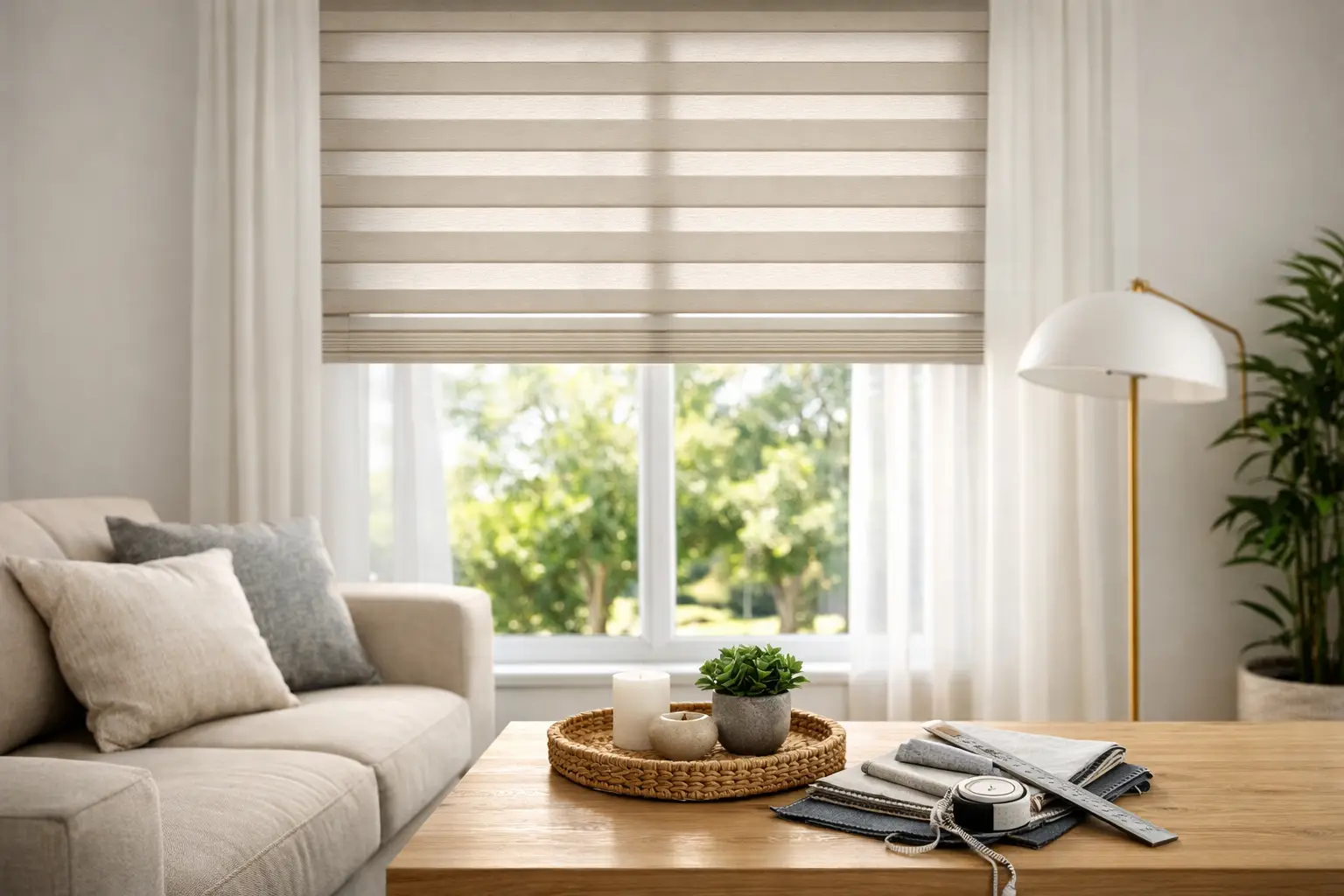
Day and night blinds use alternating sheer and opaque fabric bands, allowing you to soften daylight while retaining a degree of privacy. They suit modern interiors and rooms where light levels change throughout the day. They are not usually the first choice where complete darkness is essential, but they are a flexible answer for living spaces and home offices.
Start with the room, not the fabric book
It is tempting to fall in love with a fabric first. However, a more reliable route is to consider what the room needs before narrowing down colours and patterns. Think about privacy, the direction of the sun, how often the blind will be used and whether children or pets are likely to be nearby.
In a kitchen, wipe-clean or moisture-resistant materials can make everyday life easier. In a bedroom, light control and warmth tend to lead the decision. In a sitting room, appearance may take greater priority, making a lined Roman blind or a blind paired with curtains an appealing option. For a home office, glare on screens is often the key issue, so an adjustable Venetian or light-filtering roller blind may be more useful.
Also consider the proportions of the window. A bold print on a small Roman blind can become a lovely focal point. On a large expanse of glazing, the same fabric may feel dominant. Conversely, a plain or gently textured fabric can give a room calm without looking flat, especially when the material has a visible weave.
Measuring: where precision makes the difference
Measuring for blinds sounds simple, but the details matter. First decide whether the blind will sit inside the recess or outside it. For a recess fit, measurements need to account for the narrowest point of the opening and any obstructions such as handles, tiles or uneven plaster. For an exact fit outside the recess, you need enough overlap to cover the window attractively and limit light gaps.
Bay windows and shaped openings require even more care. The angles between sections, the projection of the blind and the room needed for brackets can all affect the result. A measurement that looks right on paper may leave blinds touching when they are raised, or prevent a window from opening as expected.
This is where a professional survey can provide real reassurance. An experienced measurer will assess the window, identify potential issues before production and advise on the fitting position. It removes the uncertainty of deductions, clearances and hardware, especially when several blinds need to work together across one room.
Fitting and finishing details
The fitting method affects both the appearance and everyday use of a blind. Recess fitting gives a tidy, built-in effect, but may not suit every window. Face fixing above or beyond the recess can make a window appear larger and may provide better light coverage. It is often the more practical option where handles protrude or the recess is shallow.
Controls deserve thought as well. Chains, cords and wand controls each suit different blind types, and child safety fittings should always be considered in family homes. Motorised options can be particularly useful for tall, awkward or hard-to-reach windows, as well as rooms with several blinds operated at the same time.
Small details make a large visual difference. The colour of a cassette or headrail, the choice of bottom bar, the direction of a Venetian slat and the placement of a chain all contribute to a polished finish. These are the decisions that are easier to make when you can see samples in your own light and talk them through with someone who understands the product.
Choosing a service you can trust
A made-to-measure blind should feel like a considered part of the room, not a compromise made under pressure. Look for a service that takes time to understand your home, offers a substantial fabric range and manages the process from design advice through to fitting. Hand-finished workmanship and professional installation bring confidence that the blind will look right, operate properly and continue to do its job over time.
At Country Interiors, this personal approach is built around helping homeowners make confident choices, with expert measuring, carefully made window dressings and fitting carried out with care. That attention is particularly valuable when coordinating blinds with curtains, shutters or soft furnishings across a wider interior scheme.
If you are unsure where to begin, stand in the room at different times of day and notice what the window is asking for: softer light, more privacy, greater warmth, a stronger design detail or simply a neater finish. That simple observation is often the best starting point for a blind you will enjoy living with for years.