
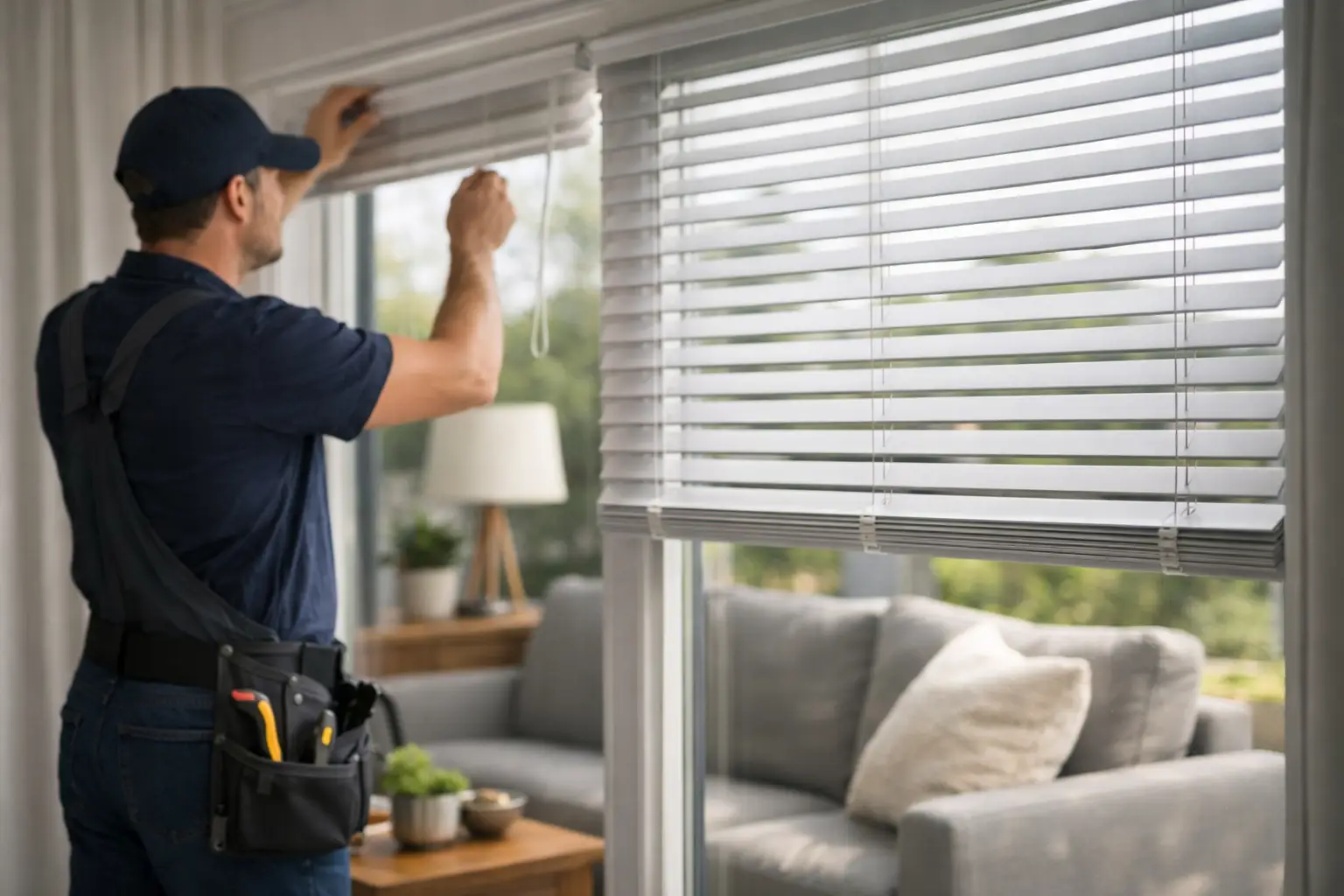
A blind can look straightforward in a showroom, yet its success is decided at the window. The real professional blind fitting benefits are seen in the details: a blind that sits neatly within its space, operates smoothly each day and complements the character of the room rather than distracting from it. For homeowners, professional fitting turns a carefully chosen blind into a finished part of the home.
Made-to-measure blinds are an investment in comfort, privacy and style. Having them measured and installed by an experienced fitter removes much of the uncertainty, particularly where windows are older, walls are uneven or the treatment needs to work around handles, deep sills or opening doors. It is a considered service designed to help houses feel more settled and complete.
A precise fit starts with expert measuring
Windows are rarely as simple as they appear. A recess may narrow towards the back, plaster can be uneven, and a bay window may contain subtle changes in angle that affect how a blind hangs and operates. Measuring only the visible width and drop can leave little room for these variations.
A professional survey considers the whole window area. This includes the depth of the recess, the position of handles, vents and alarm sensors, the direction in which windows and doors open, and the clearance needed for the blind to move freely. The fitter can also advise whether the blind will look and perform best inside the recess, outside it, or above the window to create a more generous visual height.
That precision matters whether you are choosing a practical roller blind for a kitchen, soft Roman blinds for a lounge, or Venetian blinds for a study. A made-to-measure finish should feel intentional, with balanced proportions and no awkward gaps that compromise privacy or light control.
Professional blind fitting benefits beyond appearance
A neatly fitted blind is pleasing to look at, but the practical advantages are just as valuable. The correct brackets, fixings and placement help the blind bear daily use without becoming loose or misaligned. A fitter will select an appropriate fixing point based on the wall, lintel or frame, rather than relying on a one-size-fits-all approach.
This is especially reassuring for larger or heavier treatments. A wide Roman blind, for example, needs secure support and careful positioning so that it raises evenly. Plantation shutters and shaped blinds also demand accurate installation if their panels, louvres or controls are to work as intended.
Professional fitting can make a noticeable difference to how comfortably a room works. Better coverage supports privacy, while carefully positioned blinds can reduce glare at a television or home-working desk. In bedrooms, the right style and fit can help manage early morning light. The best choice will depend on the room, the orientation of the window and how you use the space, which is why personal advice is often more useful than selecting solely from a photograph.
Safer, smoother everyday operation
Blinds should be easy to live with. During installation, an experienced fitter checks that the control mechanism is accessible, level and operating correctly. Chains and cords can be secured with the appropriate safety devices, and the final position can be adjusted where needed to give a tidy, practical result.
For homes with young children or visiting grandchildren, blind safety deserves particular attention. A professional will discuss suitable control options and ensure relevant safety components are fitted properly. This offers welcome peace of mind without compromising the look of the finished window.
The same care applies in busy family homes, kitchens and bathrooms, where blinds may be opened and closed several times a day. Correctly aligned components place less strain on the mechanism, helping the blind remain reliable over time. There is a trade-off, of course: the lowest-priced ready-made option may initially seem attractive, but it may not provide the tailored coverage, quality materials or long-term operation that a bespoke treatment can offer.
Design advice that suits the room
Blind fitting is not simply the final appointment. It works best as part of a complete process, beginning with a conversation about the room and the atmosphere you would like to create. The ideal blind should respond to practical needs while adding warmth, texture and colour to the interior.
In a south-facing room, for instance, you may want to soften strong sunlight without making the space feel closed in. In a bathroom, moisture-resistant materials and easy cleaning may be the priority. For a period property, a Roman blind in a carefully chosen fabric can bring softness to a window while respecting the home’s character. Contemporary spaces may suit clean-lined rollers, sleek Venetians or shutters with crisp, architectural appeal.
A professional can show how the blind will relate to paint colours, flooring, furniture and any existing curtains. This is particularly helpful when dressing several rooms, where small decisions about fabric, trim and fitting position can create a more cohesive result throughout the house. It also avoids the disappointment of choosing a colour or texture that looks different once it is placed against your own walls and natural light.
Less disruption, more confidence
Fitting blinds yourself can be satisfying for a simple, standard-sized window, provided you are confident with measuring, drilling and checking the mechanism. However, the process can become time-consuming when windows are large, unusual or difficult to access. It can also be frustrating to discover that a blind has been ordered to the wrong dimensions or that a bracket cannot be securely fixed where expected.
Professional installation takes that responsibility away from the homeowner. Measurements are taken before manufacture, the finished blind is brought ready to install, and the fitting is completed with attention to alignment and operation. Any small adjustments can be made on site, leaving the room clean, usable and ready to enjoy.
For many people, this is one of the most meaningful professional blind fitting benefits: confidence from the first decision to the final fitting. There is no need to second-guess recess measurements, work out which screws are suitable, or spend a weekend correcting a crooked installation. Instead, you can focus on the pleasure of seeing the room take shape.
A finish that protects your investment
Quality blinds are made to be used, not merely admired. Looking after the fitting from the outset helps protect that investment. When a blind is level, properly supported and suited to its location, it is more likely to continue performing well through daily life.
At Country Interiors, the service brings together design guidance, careful measuring, made-to-measure craftsmanship and professional fitting, so each element is considered as part of the finished room. This is particularly valuable where window treatments need to work alongside curtains, cushions, upholstery or shutters for a coordinated home interior.
A professional fitting does not mean every home must have the most elaborate blind available. Sometimes a simple roller blind is exactly right. What matters is that the treatment is chosen for the window, measured accurately and installed with care. Those quiet details are what make a blind feel less like an addition and more like it has always belonged there.