
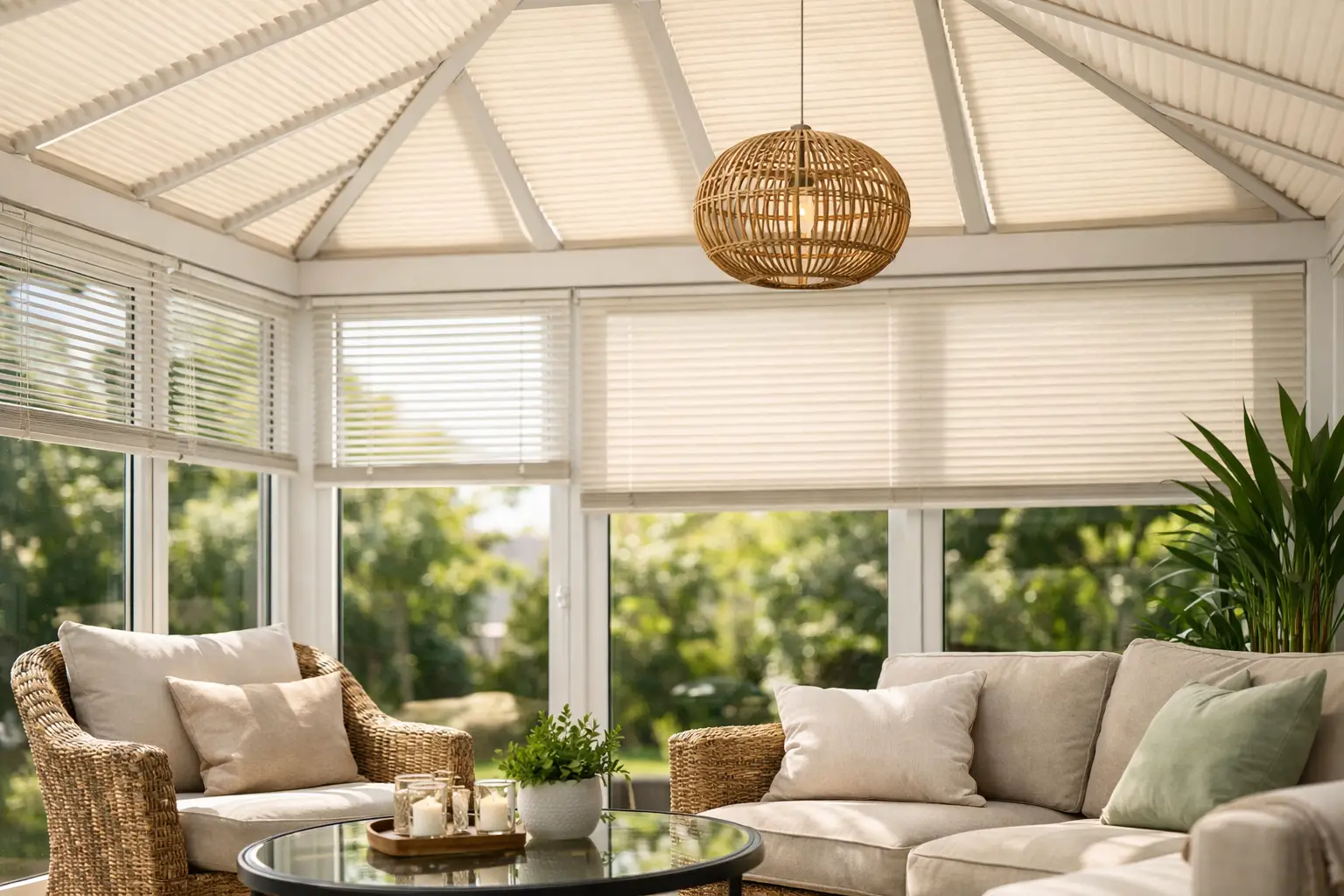
A conservatory can be the brightest room in the house at breakfast and the hardest to enjoy by mid-afternoon. Glass that welcomes a lovely view can also bring glare, excess warmth and a surprising lack of privacy. Choosing blinds for conservatories is therefore about much more than finding a colour you like. The right design should make the room comfortable to use, complement the rest of your home and fit every window with care.
Unlike an ordinary window, a conservatory has several surfaces to consider: side windows, doors, roof panels and often unusual shapes. Each responds differently to sun and shade throughout the day. A professional survey gives you the confidence that every blind will sit neatly, operate smoothly and provide the coverage you need.
Start with how you use the room
Before looking at fabrics or finishes, think about when your conservatory is used most. A garden room used for morning coffee needs a different solution from one that doubles as a dining space, home office or playroom. If the room faces south or west, managing strong afternoon sun is likely to be the priority. For a north-facing conservatory, you may be more concerned with retaining a light, airy feel while adding softness and privacy.
Also consider what is immediately outside. Overlooked gardens, neighbouring windows and busy roads can make privacy an important part of the brief. Blinds allow you to keep the room open and welcoming in daylight, then create a more sheltered atmosphere as evening arrives.
It is worth being realistic about seasonal use, too. No blind can turn a poorly insulated conservatory into a fully climate-controlled extension, but well-chosen window dressings can make a noticeable difference to glare and solar heat. Combined with suitable ventilation, they help the room feel more pleasant across the year.
Choosing blinds for conservatories by window type
The most successful schemes rarely rely on a one-size-fits-all product. Roof blinds and side-window blinds have different jobs, and selecting each with the overall look in mind creates a considered result.
Pleated and cellular blinds for roof panels
Pleated blinds are a popular choice for conservatory roofs because their slim profile works well within glazing bars and shaped panels. They soften direct sunlight without making the ceiling feel heavy, and can be made to fit neatly within individual sections of glass.
Cellular blinds have a similar tailored appearance, but their honeycomb construction provides an additional layer that can help reduce heat transfer. They are particularly worth considering where sun pours through the roof for long periods. The trade-off is that very insulating fabrics may slightly reduce the crisp, open feeling some homeowners want from a glass roof, so fabric colour and opacity matter.
For high or difficult-to-reach roof areas, motorised operation can be a practical addition. Rather than leaving blinds in one position because they are awkward to adjust, you can control light as conditions change. This is especially useful in conservatories with large roof spans.
Roller blinds for a clean, contemporary finish
Roller blinds suit conservatory side windows and doors where you want a simple, uncluttered look. Available in an enormous choice of fabrics, they can provide anything from gentle light filtering to more effective glare reduction and privacy. A moisture-resistant fabric can also be sensible if the room is prone to condensation.
The fabric selection is key. A pale, translucent material maintains a connection with the garden and diffuses harsh light, while a denser or dim-out fabric is better for television screens, working at a desk or creating privacy in the evening. Blackout fabrics are useful in some situations, though they can feel too severe if used across every panel in a room designed to enjoy the outdoors.
Perfect Fit blinds for doors and tilt windows
Where blinds are fitted to uPVC windows or doors, Perfect Fit systems can be an elegant option. They are designed to sit within the frame, rather than hanging in front of it, so the blind moves with the door or window. This makes them particularly useful on frequently used patio doors and French doors, where free movement is essential.
Because there are no loose control cords or chains hanging across the glass, they offer a tidy finish for family spaces. The suitability depends on the frame and glazing bead, which is why accurate measuring and professional advice are so valuable before making a decision.
Roman blinds for warmth and character
A conservatory does not have to look purely functional. Roman blinds can bring the softness and character of the rest of your home into side windows, particularly in an orangery-style space or a conservatory that opens into the kitchen or living room. With thousands of fabrics available, they offer a chance to introduce pattern, texture or a colour carried through from curtains and cushions elsewhere.
They are generally best suited to vertical windows rather than roof sections. A lined Roman blind can make an evening seating area feel much cosier, but it will stack higher than a roller or pleated blind when raised. In rooms where preserving every inch of glass is the priority, a slimmer blind may be the better fit.
Balance light control with the view
A conservatory earns its place by bringing you closer to the garden. That is why the darkest or thickest fabric is not automatically the best choice. You may only need stronger shading on the roof and sun-facing elevations, leaving other windows in a lighter filtering fabric to retain a bright outlook.
Colour affects the atmosphere as well as the practical performance. Soft neutrals, warm whites and gentle natural shades reflect the relaxed quality many homeowners want in a garden room. Greys, greens and muted blues can give a more contemporary feel while still working beautifully with planting outside. Pattern can be effective on side blinds, but consider how it will look against multiple panes of glass. A small-scale design often feels calmer than a bold print repeated across a whole conservatory.
If your aim is to reduce glare without closing off the view, specialist solar-reflective or screen fabrics may be appropriate. These can soften intense sunlight while allowing some outward visibility during the day. At night, however, privacy can be different when interior lights are on, so it is wise to discuss both daytime and evening use.
Do not overlook safety, operation and fitting
A blind that looks lovely but is difficult to operate soon becomes a blind that stays in one position. Consider which windows you open, which doors are used daily and whether roof blinds need to be adjusted regularly. Chain-operated, corded, spring-assisted and motorised systems each have their place, but the best option depends on the size, position and purpose of the blind.
Child safety should always be considered in family homes. Appropriate safety devices and tensioned systems help keep controls neat and secure. For roof installations, dependable brackets, precise tension and careful fitting are equally important. These are not areas where guesswork pays off.
Conservatory windows are often slightly different in size, and even small measuring errors can leave gaps, cause fabric to catch or make an otherwise attractive scheme look unfinished. Made-to-measure blinds allow for the detail that ready-made products cannot always accommodate: the depth of frames, handles, opening directions, roof angles and the relationship between each panel.
Create a scheme that belongs to the whole house
The best conservatory blinds feel connected to the rooms around them. If the space leads from your kitchen, draw on its cabinet colours, worktop tones or dining chairs. If it sits beside a lounge, a complementary fabric or trim can make the transition feel natural. You do not need to match every window treatment exactly; a shared colour family or texture is often enough.
At Country Interiors, this is where a personal consultation can make the process feel far less daunting. Seeing fabrics in your own light, talking through the way you use the room and having every window measured properly helps turn a collection of glass panels into a comfortable, finished part of your home.
Take time to picture the room on a bright July afternoon and a dark January evening. The blinds that serve both moments well will not simply dress the windows – they will help your conservatory become a room you enjoy using every day.